Skip to content
Practical Asian cooking techniques, transparent cookware research, and complete kitchen references
Asian Solutions logo Asian SolutionsCook smarter at home
Research-based buying guide · Updated August 6, 2026

The 6 best woks for home cooks, matched to your stove and cooking style.

Our top recommendation for most kitchens is the Yosukata 13.5-inch carbon-steel wok. The better choice may be different, however, when you have a small kitchen, a powerful gas burner, an induction range, or a preference for heavy cast iron.

How we researched this guide and how affiliate links work

Asian Solutions has not completed hands-on testing of every wok on this page. Recommendations are based on manufacturer specifications, stove compatibility, design analysis, and findings reported by established independent test publications. Links to Amazon may earn us a commission at no extra cost to you.

Carbon-steel wok with wooden handle on a transparent background
At a glance

Quick comparison

Start with your stovetop. A wok that cannot sit securely or receive heat efficiently is the wrong wok, no matter how traditional or highly rated it is.

ProductMaterialSizeBottomCompatible cooking setupsAvailability
Yosukata 13.5-Inch Black Carbon Steel Wok product image on white background
Yosukata 13.5-Inch Black Carbon Steel WokBest overall for most home cooks
Carbon steel13.5 inchesFlatGas, electric, ceramic, induction, grill, and open fireCheck price on Amazon
OXO Obsidian 12-Inch Carbon Steel Wok product image on white background
OXO Obsidian 12-Inch Carbon Steel WokBest compact wok
Carbon steel12 inchesFlatGas, electric, ceramic, induction, and grillCheck price on Amazon
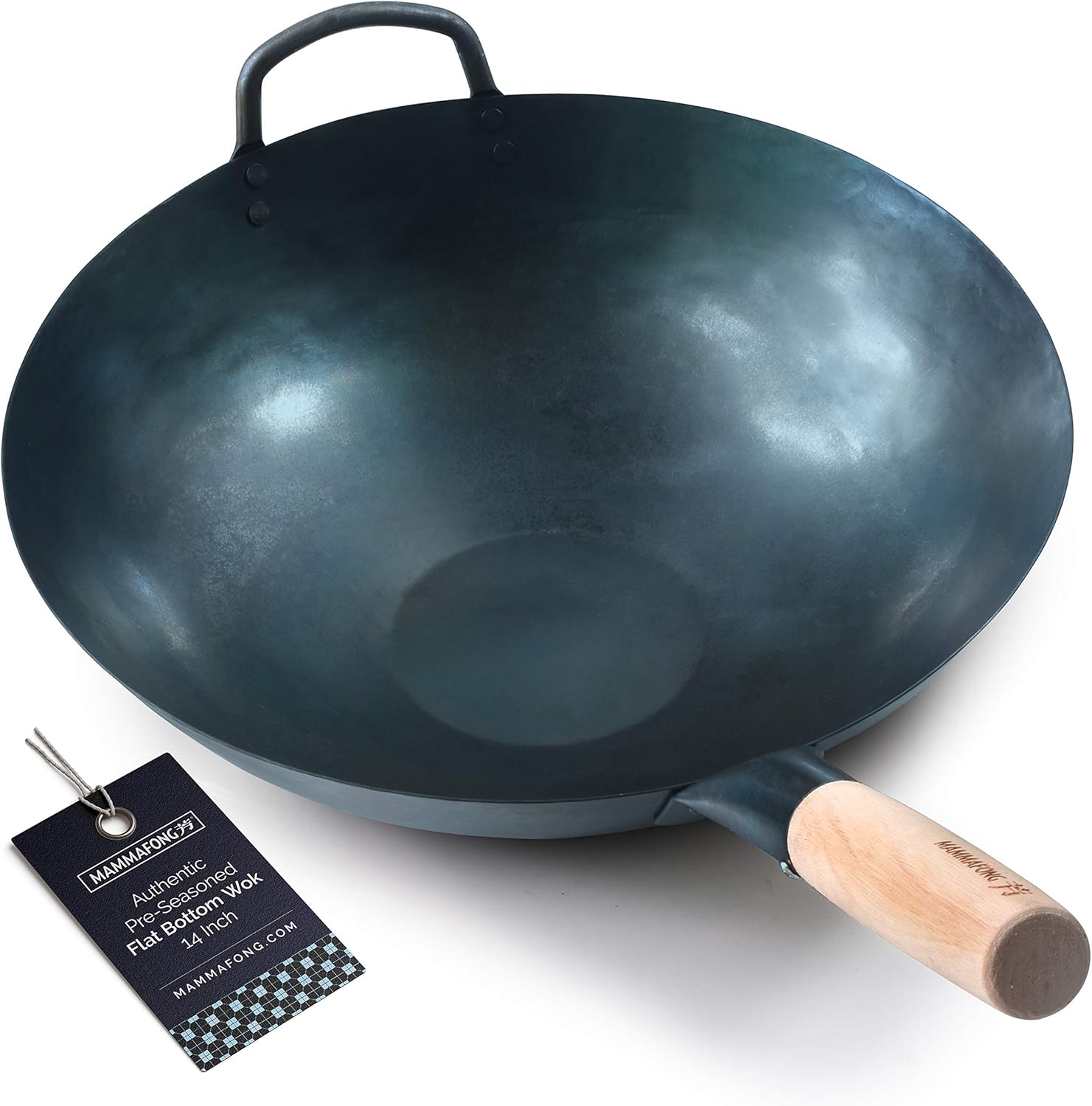
Mammafong 14-Inch Pre-Seasoned Blue Carbon Steel Wok product image on white background
Mammafong 14-Inch Pre-Seasoned Blue Carbon Steel WokBest premium hand-hammered flat-bottom wok
Carbon steel14 inchesFlatGas, electric, ceramic, and inductionCheck price on Amazon
Craft Wok 14-Inch Traditional Hand-Hammered Wok product image on white background
Craft Wok 14-Inch Traditional Hand-Hammered WokBest traditional round-bottom wok for gas
15-gauge carbon steel14 inchesRoundGas burner, wok burner, grill, and open flameCheck price on Amazon
Made In 13.5-Inch Seasoned Carbon Steel Wok product image on white background
Made In 13.5-Inch Seasoned Carbon Steel WokBest premium modern carbon-steel wok
Carbon steel13.5 inchesFlatGas, electric, ceramic, and inductionCheck price on Amazon
Lodge 14-Inch Seasoned Cast Iron Wok product image on white background
Lodge 14-Inch Seasoned Cast Iron WokBest for heat retention and stationary cooking
Cast iron14.31 inchesIntegrated stable baseGas, electric, ceramic, induction, oven, grill, and campfireCheck price on Amazon
Editorial method

How we researched and selected these woks

This page is deliberately labeled research-based. We do not convert other publications’ test results into a claim that Asian Solutions performed those tests.

1. Stove fitWe eliminated combinations that do not make physical sense, such as a traditional round-bottom wok on a flat induction surface.
2. Material behaviorWe compared heat response, heat retention, weight, seasoning needs, and cleaning obligations.
3. Independent evidenceWe checked conclusions from Serious Eats, Allrecipes, Food & Wine, and other established test publications.
4. Manufacturer verificationDimensions, materials, compatibility, and care details were checked against current manufacturer or retailer listings.
What we did not do: We did not claim to cook identical recipes in all six woks, take thermal measurements, or conduct long-term durability testing. Those require a controlled, hands-on testing program and are planned for future updates.
Best overall for most home cooks

1. Yosukata 13.5-Inch Black Carbon Steel Wok

The Yosukata is the most balanced choice in this guide because it combines the traits most home cooks actually need: a flat base, responsive carbon steel, useful capacity, a long wooden handle, a helper handle, and compatibility with common household stovetops.

MaterialCarbon steel
Diameter13.5 inches
BottomFlat
Best fitMost gas, electric, and induction kitchens

Advantages

  • Strong consensus across several independent test publications.
  • Flat base is practical on household burners.
  • Responsive enough for fast heat adjustments.
  • Wooden handle and helper handle improve control.

Trade-offs

  • The factory seasoning is a starting layer, not permanent nonstick.
  • Must be dried and oiled after washing.
  • Large batches can still crowd the cooking surface.
  • Exact listed weight varies by version and retailer.

Why it is our first recommendation

A good home wok must solve a different problem from a restaurant wok. Restaurant burners concentrate intense heat beneath a round bowl. Most home ranges produce a broader, weaker flame or use a flat electric or induction element. The Yosukata’s flat base improves contact and stability while preserving sloped sides for tossing, stirring, steaming, and moving food through hotter and cooler zones.

Independent test publications have repeatedly selected this family of Yosukata woks as a leading performer. Their observations commonly emphasize quick heat response, manageable handling, and a surface that becomes increasingly slick as the seasoning develops. We treat those findings as external evidence, not as Asian Solutions’ own hands-on testing.

Where it makes the most sense

This model suits stir-fries serving roughly two to four people, fried rice cooked in sensible batches, shallow-frying, braising, steaming with a rack or basket, and high-heat vegetable cooking. Its 13.5-inch rim gives ingredients room to move without making the pan as cumbersome as many 16-inch woks.

Carbon steel does not hold heat like a massive cast-iron vessel. That is an advantage when you need to lower the temperature quickly after searing aromatics or prevent a sauce from scorching. It is also why preheating and cooking in batches matter. A home burner cannot instantly recover when a cold pile of meat and vegetables is dumped into the pan.

What buyers should know about seasoning

“Pre-seasoned” should be interpreted as corrosion protection and a head start. The surface will change color, become patchy, darken, and improve with repeated thin layers of polymerized oil. That visual change is normal. The wok is not coated with a permanent synthetic nonstick layer, so delicate foods may stick until the surface and your heat control improve.

Best compact wok

2. OXO Obsidian 12-Inch Carbon Steel Wok

The OXO Obsidian is the easiest pick for cooks who value a smaller footprint, a familiar skillet-like handle, and a removable silicone sleeve. Its 12-inch size is less spacious than a 14-inch wok, but it is easier to store, wash, and control.

MaterialCarbon steel
Diameter12 inches
BottomFlat
Best fitOne to three portions and smaller kitchens

Advantages

  • Compact and easier to maneuver.
  • Pre-seasoned carbon-steel surface.
  • Removable silicone sleeve improves grip comfort.
  • Useful on a stovetop or grill.

Trade-offs

  • Less capacity for family-size stir-fries.
  • Overcrowds more quickly than 13.5- or 14-inch woks.
  • The sleeve must be removed for some high-heat uses.
  • Still requires carbon-steel maintenance.

Why choose a smaller wok?

The common advice to buy a 14-inch wok assumes the cook has enough burner power, storage, sink space, and physical leverage to use it. A 12-inch wok can be the smarter tool for a couple, a solo cook, or anyone who mostly prepares one protein and one vegetable at a time. It reaches cooking temperature with less total metal to heat and feels less unwieldy when moving food.

The compromise is surface area. Stir-frying depends on evaporation. If too much wet food is packed into a small wok, liquid accumulates faster than the burner can drive it off. The OXO works best when ingredients are dried well and cooked in batches.

Handle design and daily use

OXO’s removable silicone sleeve makes the handle feel more familiar to cooks moving from conventional skillets. It can also be removed for higher-heat applications according to the current instructions. The helper handle is useful when transferring a full wok because one-handed lifting becomes less comfortable as food and sauce add weight.

This is not a maintenance-free nonstick pan. Its natural seasoning will improve, degrade, and rebuild depending on temperature, oil, acidity, and cleaning. Buyers willing to accept that cycle get a versatile compact wok. Buyers who want dishwasher convenience should choose another cookware type.

Best premium hand-hammered flat-bottom wok

3. Mammafong 14-Inch Pre-Seasoned Blue Carbon Steel Wok

Mammafong’s 14-inch flat-bottom wok is for cooks who want a more traditional hand-hammered look without giving up the stability required by a household stovetop.

Material100% carbon steel
Diameter14 inches
Approx. weight3.3 lb
Approx. gauge16 gauge, 1.2 mm

Advantages

  • Large 14-inch working area.
  • Hand-hammered bowl with machine-pressed flat base.
  • Relatively manageable listed weight.
  • Natural pre-seasoning process.

Trade-offs

  • Costs more than basic carbon-steel woks.
  • Blue-grey finish will change with use.
  • Requires careful drying and oiling.
  • Large rim needs more storage space.

What the hand-hammered construction changes

Hammer marks are often marketed as proof that food will cling to the sides while liquids pool at the center. In practice, heat control, oil, ingredient moisture, and technique matter more than texture alone. The meaningful benefit is the combination of a traditional bowl profile with a practical flat contact area.

The 14-inch diameter gives food more room than the OXO. That matters when stir-frying vegetables that release water or noodles that need space to separate. The extra room does not eliminate the need for batches, but it provides a more forgiving working area for family meals.

Who should pay the premium?

Choose the Mammafong when craftsmanship, a broad bowl, and a hand-hammered appearance matter to you. The premium is harder to justify if you simply need the most efficient route to good home stir-fries. A less expensive flat-bottom carbon-steel wok can perform the same core jobs when the cook controls heat and batch size well.

The factory surface should still be treated as a beginning. The blue finish is not meant to remain pristine. Darkening, uneven coloration, and a developing patina are signs of use rather than defects.

Best traditional round-bottom wok for gas

4. Craft Wok 14-Inch Traditional Hand-Hammered Wok

The Craft Wok is the specialist choice in this guide. Its round bottom and thick 15-gauge carbon steel make sense over a compatible gas flame or dedicated wok burner, but it is the wrong purchase for a flat electric or induction surface.

Material15-gauge, 1.8 mm carbon steel
Diameter14 inches
BottomRound
Approx. weight4.6 lb

Advantages

  • Traditional geometry for a compatible flame setup.
  • Heavy commercial-style steel.
  • Wooden main handle and steel helper handle.
  • Large, deep bowl for varied wok techniques.

Trade-offs

  • Not suitable for flat electric or induction cooktops.
  • Requires full initial seasoning.
  • Heavier than several flat-bottom alternatives.
  • May require a wok ring or compatible grate.

Why round bottom is not automatically better

A round-bottom wok can move smoothly through a concentrated flame and gives ingredients a continuous curved surface. That advantage depends on the stove. On a flat glass or induction top, the wok lacks stable contact and cannot receive heat as intended. A wok ring may stabilize it on some gas ranges, but it can also lift the pan farther from a weak household flame.

Buy this model because your cooking setup supports it, not because “round bottom” sounds more authentic. For most apartment kitchens, a flat-bottom wok transfers heat more reliably and is safer to handle.

Seasoning workload

The raw carbon-steel surface needs washing, heating, and seasoning before normal use. That process is manageable, but it is not optional. The heavier gauge may take longer to heat than a thinner wok, though it can feel steadier once hot. Owners should expect the pan to darken and to need periodic repair seasoning after acidic cooking or aggressive scrubbing.

This is the most traditional choice in the group, but also the least universal. It rewards a cook who has the right flame, wants a deeper rounded bowl, and does not mind the initial setup. Everyone else is better served by a flat base.

Best premium modern carbon-steel wok

5. Made In 13.5-Inch Seasoned Carbon Steel Wok

Made In’s wok brings a premium cookware approach to the category: a riveted stainless-steel handle, a broad flat base, Swedish construction, and a seasoned carbon-steel body designed for gas, electric, and induction ranges.

MaterialCarbon steel
Total diameter13.5 inches
Cooking surface5.5 inches
WeightAbout 3.5 lb

Advantages

  • Flat base works across common cooktops.
  • Good balance between capacity and listed weight.
  • Long stainless handle supports oven use.
  • Premium warranty and polished construction.

Trade-offs

  • Substantially more expensive than basic woks.
  • Metal handle can become hot.
  • Small flat cooking zone relative to total diameter.
  • Performance still depends on seasoning and technique.

What the premium buys

The value proposition is fit, finish, handle construction, and a brand ecosystem rather than a fundamentally different cooking principle. Carbon steel remains carbon steel. It heats quickly, responds to burner changes, can rust, and requires seasoning. The Made In is attractive for buyers who want those properties in a pan that feels closer to premium Western cookware.

The 5.5-inch flat cooking surface concentrates direct contact with electric or induction elements. Food can then be moved up the sloped walls to manage temperature. That geometry is useful, but cooks should not treat the flat center like the entire cooking area of a skillet. Wok cooking depends on movement and staged additions.

Who should choose it?

Choose Made In if the higher price is acceptable and you prefer a stainless handle, polished construction, and high oven tolerance. Choose Yosukata or OXO if value and straightforward home use matter more than premium finishing.

A metal handle changes the feel of the pan. It improves oven flexibility and durability, but it can become hot and may require a towel or handle cover. Consider that trade-off before paying for a feature you may not use.

Best for heat retention and stationary cooking

6. Lodge 14-Inch Seasoned Cast Iron Wok

The Lodge is not a tossing wok. At 12.8 pounds, it is a stable, stationary cooking vessel for people who value heat retention, browning, oven use, grilling, and durability more than quick pan movement.

MaterialSeasoned cast iron
Width14.31 inches
Height4.75 inches
Weight12.8 lb

Advantages

  • Excellent heat storage and strong browning potential.
  • Stable on common stovetops, including induction.
  • Works in the oven, on a grill, or over a campfire.
  • Durable, PFAS-free seasoned surface.

Trade-offs

  • Far too heavy for normal wok tossing.
  • Slow to respond when heat needs to drop quickly.
  • Large and awkward to wash.
  • Can overcook delicate ingredients after the burner is lowered.

A different style of wok cooking

Cast iron stores more heat than thin carbon steel, so it can maintain a searing surface when cold ingredients are added. The same thermal mass makes it slower to cool. Rather than lifting and tossing the pan, you stir and turn food with a spatula while the wok remains on the burner.

This makes the Lodge useful for shallow-frying, braising, roasting, deep-frying, and large stationary stir-fries. It is less suitable for cooks who want the quick, responsive feel associated with a carbon-steel wok.

Who should avoid it?

Avoid this model when lifting restrictions, limited sink space, fragile glass cooktops, or fast temperature correction are concerns. Its dual loop handles are secure, but moving a 12.8-pound pan becomes more difficult once it contains hot oil or food.

It also requires care similar to other bare iron cookware. Dry it completely, oil it as needed, and avoid leaving acidic food in it. Its stability and heat retention are genuine strengths, but they solve a different problem from a lightweight restaurant-style wok.

Buying guide

How to choose the right wok

Choose the bottom shape before the brand

A flat-bottom wok is the default recommendation for most homes because it sits securely on gas grates, electric coils, glass-ceramic ranges, and induction elements. The flat area receives direct heat while the sloped walls preserve the movement and thermal zoning that distinguish a wok from a conventional skillet.

A round-bottom wok is best when a gas setup can support the bowl close to a concentrated flame. It is a specialized choice, not an automatic upgrade. A weak burner plus a tall wok ring can move the metal too far from the flame and reduce useful heat.

Carbon steel vs cast iron vs stainless steel vs nonstick

Carbon steel is the strongest general-purpose choice. It heats quickly, responds to burner changes, tolerates high heat, and develops a natural seasoned surface. It can rust and must be dried promptly.

Cast iron stores far more heat but is dramatically heavier. It is useful for stationary searing, frying, roasting, and braising. It is less suitable for cooks who want to lift and toss the pan.

Stainless steel avoids seasoning and is less reactive with acidic sauces, but food is more likely to stick and many stainless woks are heavier or built more like deep sauté pans.

Traditional nonstick coatings make cleanup easy, but they generally limit the high heat that makes wok cooking effective. A coated wok can be convenient for gentle cooking, but it is not our first choice for high-heat stir-frying.

The practical size range

A 12-inch wok is manageable for one to three servings and small kitchens. A 13.5- or 14-inch wok is the versatile middle ground for most households. Larger woks create more room but demand more burner output, storage, sink space, and physical control.

Weight matters more than many buyers expect

Marketing often focuses on steel thickness and durability, but a wok that is too heavy for its owner becomes a stationary pan. That is not necessarily bad, but it changes the cooking style. Consider the weight of the empty wok plus a full meal and hot oil before assuming you will toss it with one hand.

Pre-seasoned does not mean maintenance-free

Factory seasoning can reduce the first-use workload and protect the pan in shipping. It does not eliminate the need to preheat, cook with adequate oil, avoid prolonged soaking, dry the pan, and repair the surface when acidic foods or aggressive cleaning strip seasoning.

Handle configuration

A long handle makes a home wok feel more familiar and supports tilting or tossing. A helper handle is valuable when the wok contains hot liquid or a large meal. All-metal handles improve oven flexibility but can become hot. Wooden handles are comfortable on the stovetop but usually reduce oven options.

Glass-cooktop caution: Lift heavy cookware rather than sliding it. Check your range manufacturer’s guidance, especially before placing a 12.8-pound cast-iron wok on the surface.

Accessories that are actually useful

  • A broad metal wok spatula that follows the curve of the bowl.
  • A spider strainer for blanching and frying.
  • A lid for steaming, braising, and controlling splatter.
  • A steaming rack or bamboo steamer sized to the wok.
  • A high-smoke-point neutral oil for cooking and maintenance.
Ownership guide

How to care for a carbon-steel wok

  1. Wash according to the manufacturer’s first-use directions. Some factory surfaces need only rinsing, while raw steel may require thorough scrubbing.
  2. Dry with heat. Put the washed wok over low heat until moisture has completely evaporated.
  3. Apply an extremely thin coat of oil. A thick sticky layer is not better seasoning.
  4. Cook fatty, non-acidic foods early. Acidic tomato or vinegar-heavy dishes can weaken young seasoning.
  5. Remove stuck food without prolonged soaking. Hot water, a soft brush, bamboo brush, or careful scraping is usually preferable.
  6. Repair rust rather than discarding the pan. Remove the rust, wash, dry, and rebuild the seasoning.

Modern dish soap is not automatically fatal to a mature seasoning layer, but manufacturer instructions differ. The safest approach for warranty and care is to follow the specific brand’s guidance and avoid harsh dishwasher cycles.

Questions answered

Frequently asked questions

What is the best wok for an electric or induction stove?

A flat-bottom carbon-steel wok is generally the most practical. The Yosukata, OXO, Mammafong, and Made In models in this guide are designed for flat household cooking surfaces. Verify the exact listing and your induction element size before buying.

Is a round-bottom wok more authentic?

It is traditional and useful over the right flame, but authenticity does not compensate for poor contact or instability. A flat-bottom wok is usually the better functional choice on a household electric or induction range.

Is 12 inches too small?

Not for one or two people, but it crowds quickly. A 12-inch wok rewards smaller batches and careful moisture control. A 13.5- or 14-inch wok is more forgiving for family portions.

Can a carbon-steel wok be used for acidic food?

Brief contact is usually manageable, but long simmering with tomatoes, vinegar, or citrus can strip young seasoning and create metallic flavors. Stainless steel is more convenient for frequent acidic cooking.

Why does food steam instead of sear?

The usual causes are overcrowding, wet ingredients, insufficient preheating, low burner output, or adding everything at once. Cook in smaller batches and allow surface moisture to evaporate.

Does a wok need a lid?

No for basic stir-frying, but a lid makes the wok more versatile for steaming, braising, simmering, and controlling splatter.

Can I put a wok in the dishwasher?

Carbon steel and cast iron should generally be hand-washed. Dishwasher heat, detergent, and prolonged moisture can strip seasoning and encourage rust.

Which wok is easiest to maintain?

Among these picks, none is maintenance-free. OXO’s compact size is easier to wash, while Lodge’s cast iron is durable but heavy. Buyers who reject seasoning care entirely should consider stainless cookware rather than carbon steel.