

Is the Yosukata 13.5-inch wok worth buying?
For most buyers comparing their first serious carbon-steel wok, yes. It offers the material, size, base shape, and handle arrangement that make sense in a normal home kitchen. The purchase is worthwhile only when the owner understands that seasoning and technique are part of the product.
Buy it if
- You use a household gas, electric, ceramic, or induction stove.
- You regularly cook stir-fries, fried rice, noodles, vegetables, meat, or steamed dishes.
- You want cookware that can tolerate high heat and metal utensils.
- You are willing to hand-wash, dry, and maintain carbon steel.
- You prefer one versatile wok instead of separate pans for frying, steaming, and braising.
Skip it if
- You want a dishwasher-safe pan.
- You expect synthetic-nonstick behavior from the first meal.
- You frequently simmer acidic tomato or vinegar-heavy dishes for long periods.
- You dislike cookware that darkens, stains, and develops a patchy patina.
- You already own a dedicated round-bottom wok and powerful outdoor burner.
Specifications and what they mean in practice
The Yosukata is sold as a 13.5-inch, flat-bottom, pre-seasoned black carbon-steel wok. Current listings describe compatibility with gas, electric, glass-ceramic, induction, grills, camping stoves, and open flame. Retailer and independent-test listings vary slightly on exact weight, so it is safer to treat it as a medium-weight home wok rather than promise one universal figure.

How we evaluated the Yosukata without pretending we tested it
This page is designed to be useful before Asian Solutions obtains a sample. It combines product-specific research with transparent limits rather than turning external test results into fake first-person experience.
What independent testing currently tells us
Independent consensus is unusually strong for this product. Serious Eats’ current tested wok guide identifies a Yosukata as its best performer and describes quick, even cooking along with manageable one-handed movement. Allrecipes names the 13.5-inch Yosukata its top choice. Food & Wine also places the Yosukata first, emphasizing heat responsiveness, usability, and handle comfort while noting that part of the factory seasoning wore away during aggressive high-heat testing.
Its tested roundup favored Yosukata for cooking performance, maneuverability, and a surface that behaved well during testing.
Read the tested roundup →Its current tested guide names the 13.5-inch Yosukata the top overall wok based on performance and design.
Read the tested roundup →Its testers praised responsive heat and the comfortable handle, but reported that some factory seasoning stripped during high heat.
Read the tested roundup →That agreement makes the Yosukata a safer research-based recommendation than a product supported only by manufacturer copy or customer star ratings. It does not remove the need for Asian Solutions to perform its own future tests, especially for seasoning durability, low-output burners, induction behavior, cleaning, and long-term flatness.
Design and construction
The flat bottom is the feature that makes it practical
A flat-bottom wok is not merely a compromise for Western kitchens. It is the shape that allows stable contact with electric coils, ceramic glass, and induction elements while remaining secure on most gas grates. The Yosukata preserves sloped sides around that flat center, so food can still move between hotter and cooler areas.
The direct-contact center is smaller than the total 13.5-inch diameter. That is normal. Wok cooking uses the center for intense heat and the sides for movement, holding, evaporation, and staged cooking. Buyers expecting the entire base area of a 13.5-inch skillet may misunderstand the geometry.
Carbon steel favors response over stored heat
Carbon steel heats and cools more quickly than a heavy cast-iron wok. That responsiveness is valuable when aromatics threaten to burn, sauce is added, or the cook needs to lower heat after searing. The trade-off is that a household burner can lose momentum when overloaded with cold or wet ingredients.
That is why the Yosukata should be judged alongside technique. Preheat the metal, dry ingredients, stage components, and cook large portions in batches. A responsive wok cannot create burner power that the stove does not have.
The handle arrangement is well suited to home use
The long wooden handle provides skillet-like leverage and limits heat transfer during stovetop cooking. A helper handle becomes valuable once the wok contains hot oil, broth, or a full meal. Moving a loaded wok with two hands is safer than treating one-handed tossing as a requirement.
The wooden handle also deserves caution around ovens, grills, and open flame. The carbon-steel body may tolerate high heat, but the complete assembly has different limits. Follow current Yosukata guidance and keep direct flame away from the wood.
Expected performance by cooking task
The observations below combine material science, geometry, manufacturer guidance, and external testing. They are informed expectations, not claims from an Asian Solutions test kitchen.
Vegetable stir-fries
This is the Yosukata’s clearest use case. The bowl provides room to toss or stir vegetables while the carbon steel responds quickly to burner changes. Dry vegetables, a fully heated wok, and a sensible batch size are essential. Wet leafy greens or an overloaded pan can release more steam than a home burner can remove.
Meat and poultry
For browning, add drained meat in a modest layer and allow initial contact before constant stirring. Velveted meat can remain tender, but marinade moisture still cools the pan. The wok’s sloped sides allow cooked pieces to be moved away from the hottest center while another batch sears.
Fried rice
Cold, separated rice usually behaves better than freshly steamed rice. The Yosukata has enough volume for a family batch, but the effective searing zone is smaller than the rim. If rice is compressed into a deep mound, it will steam. Break up clumps before cooking and add sauce gradually.
Noodles
The curved walls make turning and separating noodles easier than in a shallow skillet. Drain noodles thoroughly and have sauce measured before cooking. Excess water and slow preparation are more likely to cause sticking than the brand of wok alone.
Eggs and delicate foods
A well-developed seasoning layer can become low-stick, but carbon steel should not be marketed as identical to a coated nonstick pan. Eggs reveal preparation errors quickly. The surface, oil, and temperature all need to be right, and a new wok may need time before delicate foods release consistently.
Steaming, braising, shallow-frying, and deep-frying
A lid and rack turn the wok into a steamer for dumplings, fish, vegetables, and bao. Its depth supports braising and frying, though oil pools deeply at the center. Use a stable stove setup, leave generous headroom, and keep handles away from traffic. A wok is versatile, but hot oil makes every movement more consequential.
Confirm the size, flat bottom, black carbon-steel finish, seller, and included accessories on the current listing.
How the Yosukata fits different stovetops
Gas ranges
Gas can heat the center and lower sidewalls, making it the most intuitive indoor match. Use the strongest stable burner that suits the base, but do not expect a standard residential flame to behave like a restaurant wok burner. Preheating and batch size remain important.
Induction
Carbon steel is magnetic, and the flat base creates the required contact. Induction can heat the center extremely quickly, so power should be increased progressively. Maximum boost on a cold pan may overheat oil or concentrate stress in the base before the upper bowl warms.
Electric coil
The flat center sits securely over a coil, but heat changes are slower than on gas or induction. Anticipate the lag. Moving the wok partially away from the element or changing stages earlier can help prevent burning.
Glass-ceramic ranges
The flat base is appropriate, but the wok should be lifted rather than dragged. Carbon residue, rough seasoning, or trapped debris can mark the glass. Follow the range manufacturer’s cookware guidance.
Grills, camping stoves, and open flame
The listing promotes outdoor use, and carbon steel is well suited to it. Stability and handle protection matter. Use a grate that supports the flat base and prevents tipping, and keep direct flames from the wooden handle.
Seasoning, cleaning, and maintenance
“Pre-seasoned” is a beginning, not a permanent coating
The factory layer protects the steel and helps the first uses, but it can wear unevenly. Food & Wine’s high-heat testing reported that some factory seasoning stripped away. That is not automatically a product failure. Carbon-steel seasoning is renewable, and the wok’s appearance will evolve through cooking, cleaning, heat, and oil.
Buyers should expect brown, blue, black, grey, and patchy areas rather than a permanently showroom-black surface. A visually imperfect wok can cook well. A glossy, thick, sticky oil layer is not evidence of superior seasoning.
A practical after-cooking routine
- Remove food rather than storing it in the wok.
- Allow the pan to cool enough for safe handling.
- Wash with hot water and an appropriate brush or nonaggressive scrubber.
- Dry over low heat until no moisture remains.
- Wipe on a few drops of neutral oil, then wipe again until the surface appears almost dry.
- Store where condensation cannot collect.
Soap, stuck food, and rust
Modern mild dish soap is not guaranteed to destroy mature seasoning, but the manufacturer’s instructions should take priority. Prolonged soaking and dishwashers are larger concerns because water can reach exposed steel. For stuck food, use hot water, controlled scraping, or a wok brush instead of leaving the pan submerged overnight.
If rust appears, remove it, wash the area, dry thoroughly, and rebuild a thin seasoned layer. Rust is a maintenance issue. Deep pitting, structural cracks, loose handles, or serious deformation deserve a different response.
Acidic ingredients
Brief sauce additions are different from simmering tomatoes, vinegar, or citrus for an hour. Long acidic cooking can weaken seasoning and produce metallic flavors, especially on a young surface. Use stainless steel when acidic braises are a regular part of the menu.
What ownership is really like
The pan will stop looking new
The most important expectation to set is visual. A carbon-steel wok is not decorative enamel. Heat marks, oil polymerization, stripped patches, and darker zones are part of ownership. People who find this distressing may enjoy stainless steel or coated cookware more.
The first few meals may be inconsistent
A new wok, a new stove, and unfamiliar heat control create several variables at once. Food sticking during the first week does not prove the wok is defective. Repeated sticking after careful preheating, enough oil, dry ingredients, and surface maintenance may indicate that the seasoning needs repair.
The 13.5-inch size needs storage
The bowl is wider and deeper than a normal skillet. Measure cabinet depth, hanging space, and sink clearance. A wok that is inconvenient to store or wash will be used less often regardless of performance.
Durability depends on the simple parts
Carbon-steel bodies can last for years because the cooking surface can be restored. The practical wear points are handles, welds, base flatness, and corrosion caused by storage. Future Asian Solutions hands-on testing should pay special attention to those areas rather than merely testing one stir-fry.
Yosukata compared with the strongest alternatives
No single wok is best for every stove and household. These alternatives solve different problems rather than simply ranking below the Yosukata.
| Product | Choose it instead when | Main compromise | Link |
|---|---|---|---|
 OXO Obsidian 12-Inch OXO Obsidian 12-Inch |
You want a smaller footprint and easier maneuverability. | Less capacity and faster overcrowding. | View on Amazon |
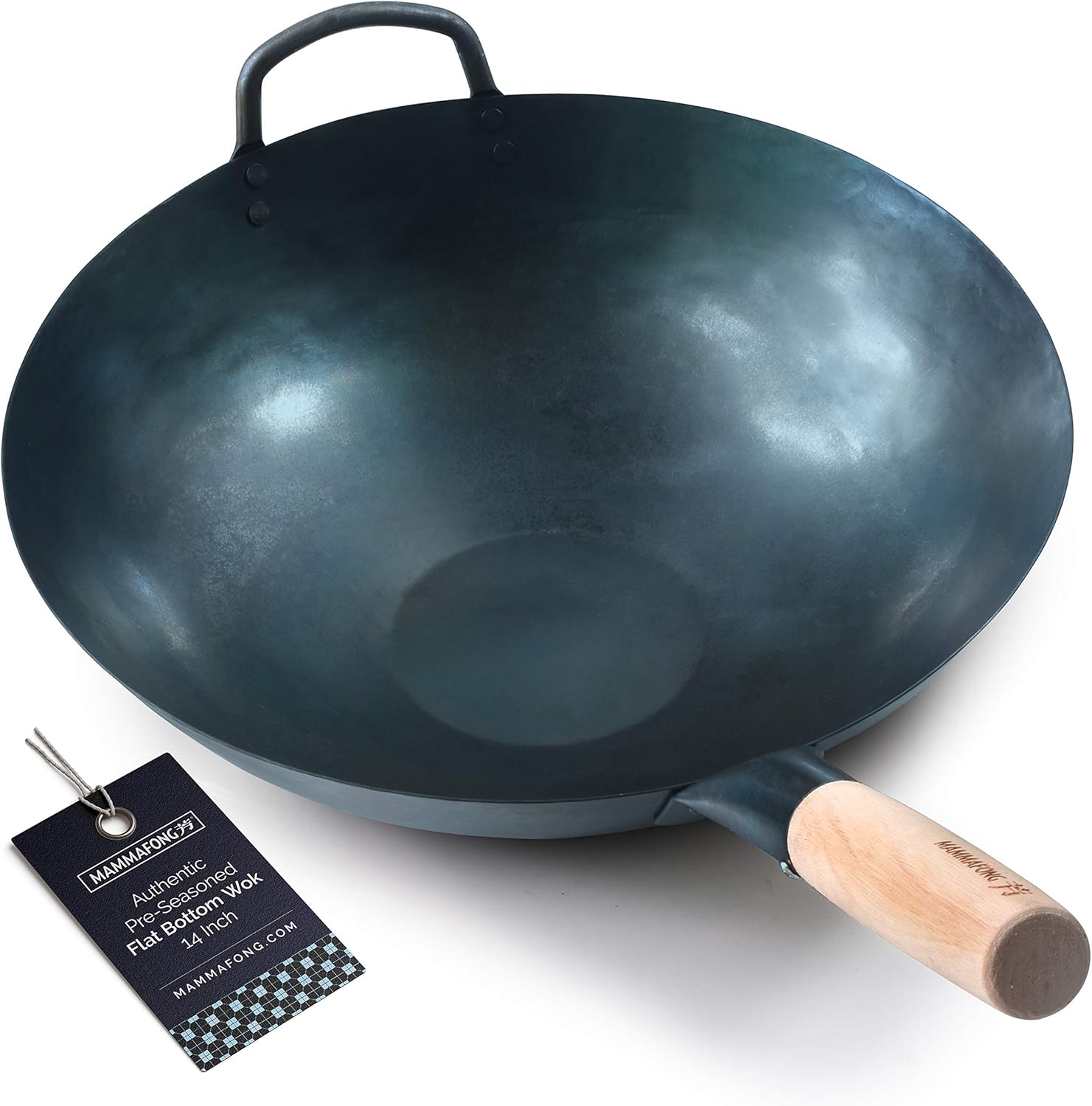 Mammafong 14-Inch Mammafong 14-Inch |
You want a premium hand-hammered presentation and a broad 14-inch bowl. | Higher cost and similar maintenance. | View on Amazon |
 Craft Wok 14-Inch Round Bottom Craft Wok 14-Inch Round Bottom |
You own a compatible gas or outdoor wok burner and want traditional geometry. | Wrong fit for flat electric, ceramic, and induction ranges. | View on Amazon |
 Lodge 14-Inch Cast Iron Lodge 14-Inch Cast Iron |
You value stationary heat retention more than tossing and fast response. | Extremely heavy and slower to cool. | View on Amazon |
Your first month with the Yosukata
Before the first meal
Confirm the model, read the included care instructions, wash away packaging residue as directed, dry the wok over heat, and inspect the handles and base. Treat factory seasoning as a starting point rather than a promise of instant nonstick performance.
During the first week
Use oil-friendly, non-acidic foods. Stir-fried vegetables, fried rice, shallow-fried items, and simple meat dishes help reveal how the wok behaves. Avoid judging it from an oversized first batch.
By the end of the first month
The surface should look different. Adjust water, heat, batch size, and preheating based on experience. If the wok rusts, review drying and storage. If it remains sticky, remove excess gummy oil and rebuild thinner layers.
After hands-on testing is added
Asian Solutions should update this page with original photographs, exact recipes, preheat times, burner details, food-release observations, cleanup notes, and long-term handle and base checks.
Common problems and likely causes
Food sticks
The wok may be underheated, overheated, poorly seasoned, too dry, overcrowded, or loaded with wet ingredients. Allow protein to sear before forcing it loose.
Stir-fry turns watery
Too much food, cold ingredients, weak preheating, or excessive marinade can overwhelm a household burner. Cook smaller batches and dry ingredients.
Seasoning feels gummy
The oil layer was probably too thick or insufficiently heated. Remove the sticky residue and rebuild with extremely thin coats.
Rust appears
Moisture reached exposed steel. Remove the rust, dry over heat, and restore a protective seasoned film.
Smoke appears immediately
The wok or oil may be too hot, or residual oil may be burning. Ventilate, lower heat, and use an appropriate high-smoke-point oil.
The base rocks slightly
Check the stove surface for debris and inspect the base when cool. Serious deformation or instability should be discussed with the seller or manufacturer.
Safety and handling
- Preheat gradually on induction and high-output burners.
- Use dry handles and a secure grip before moving the wok.
- Do not carry a wok full of hot oil unless absolutely necessary.
- Turn the long handle away from walkways and children.
- Use ventilation during seasoning and high-heat cooking.
- Keep the wooden handle away from direct flame.
- Follow safe internal temperatures for poultry, meat, and seafood.
- Lift rather than slide the wok on glass cooktops.
Frequently asked questions
Is the Yosukata wok actually nonstick?
It develops a naturally seasoned low-stick surface, but it is not equivalent to a synthetic nonstick coating. Food release depends on seasoning, oil, temperature, moisture, and technique.
Can the Yosukata wok be used on induction?
Yes. The flat carbon-steel base is induction-compatible. Use a suitable element and raise power progressively rather than immediately using maximum boost.
Does it need seasoning before the first meal?
The black version is sold pre-seasoned, but current instructions should be followed. The factory layer is a starting surface that continues to change with use.
Is 13.5 inches large enough for a family?
It is a practical size for many meals serving two to four people. Larger or moisture-heavy meals may need to be cooked in batches.
Can metal utensils be used?
Carbon steel generally tolerates metal wok spatulas. Use controlled scraping rather than gouging, and expect cosmetic marks to blend into the patina.
Why is the black surface turning brown, blue, grey, or patchy?
Heat and oil alter the steel and seasoning. Uneven color is normal. The important signs are food performance, absence of active rust, and a surface that is not covered in thick sticky residue.
Can it go in the dishwasher?
No. Dishwasher detergent, prolonged moisture, and heat can strip seasoning and cause rust.
Can I cook tomato or vinegar sauces in it?
Brief use is more manageable than long simmering. Acidic ingredients can weaken seasoning and create metallic flavors, especially on a young surface.
Does it come with a lid?
The exact listing and bundle determine included accessories. Confirm whether the current product includes a lid or whether one must be purchased separately.
Is it a good first wok?
Yes for someone willing to learn carbon-steel care. It is less suitable for a buyer who wants dishwasher cleaning and predictable coated-nonstick behavior.